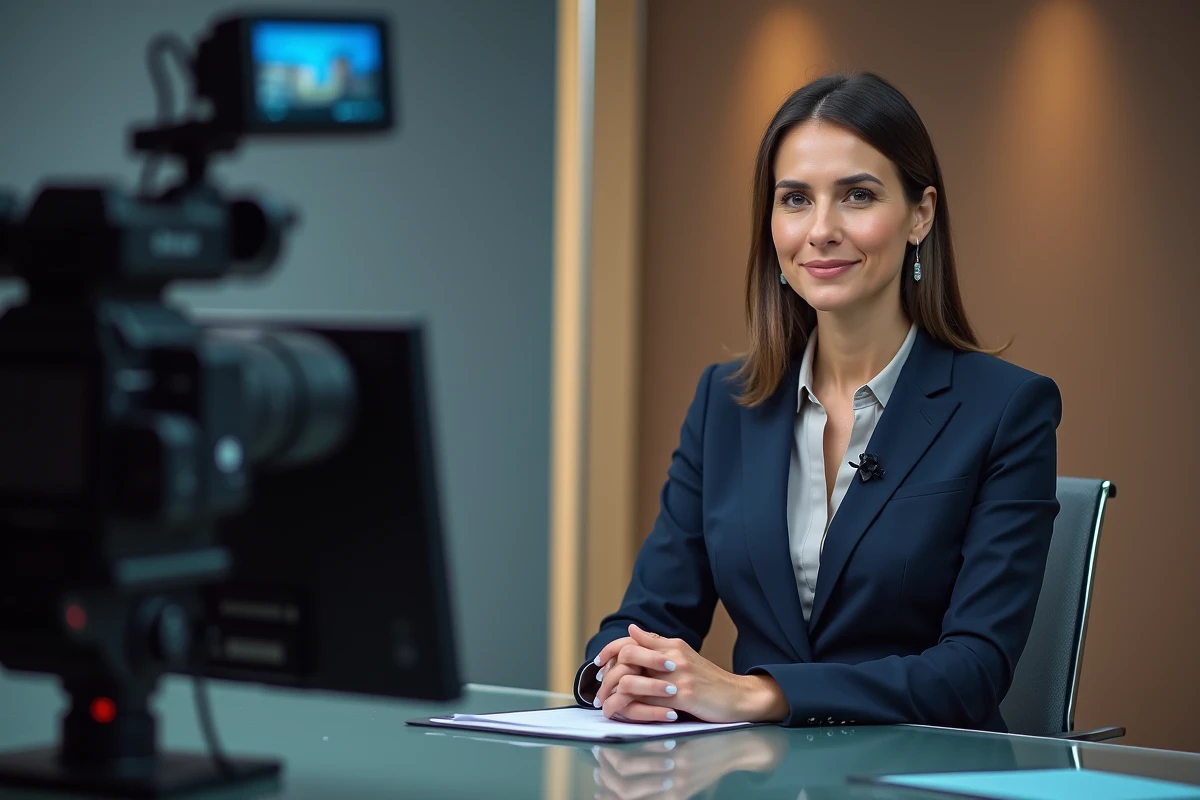
Margot Haddad presents her news segment on LCI every weekend, facing ministers, diplomats, and geopolitical analysts. Her partner, however, never appears on air or on her professional social media. This complete absence of marital mentions in the media raises a simple question: is it a personal choice, a professional constraint, or both at once?
Separation of private and public life among continuous news presenters
French continuous news channels share a common characteristic: their on-air faces show very little of their family surroundings. This phenomenon goes beyond Margot Haddad and affects the entire sector.
The main reason lies in the editorial format of political programs. When a journalist questions government officials, military personnel, or economists on sensitive topics, any information about her partner can fuel suspicions of conflicts of interest or political bias. Marital discretion acts as a credibility shield.
An article dedicated to Margot Haddad and her husband on screen further details this logic of compartmentalization between the professional sphere and the intimate sphere, which structures the communication of political journalists in France.
| Criteria | Continuous news presenters | Entertainment hosts |
|---|---|---|
| Mentions of the partner on social media | Almost nonexistent | Frequent (stories, joint posts) |
| Presence of the partner in the tabloids | Very rare, often involuntary | Regular, sometimes orchestrated |
| Content of public accounts | Focused on news and shows | Mix of professional and personal life |
| Communication objective | Neutrality, journalistic credibility | Proximity, likability |
This table illustrates a structural gap. The political news format imposes exclusively professional communication, whereas entertainment takes advantage of personal exposure.
Margot Haddad on social media: a methodical compartmentalization
An examination of Margot Haddad’s public accounts on X, Instagram, and LinkedIn reveals a consistent pattern. The posts focus on her shows, her guests, geopolitical news, or her professional collaborations. No couple photos, no allusions to married life, no tags to a personal account of a potential partner.
This is not a simple oversight. Since obtaining her own segment on LCI (Fridays, Saturdays, and Sundays in the evening), Margot Haddad has deliberately professionalized her accounts. The choice is both editorial and personal.
Several elements confirm this strategy:
- Her X account mentions only her roles at LCI, her time at CNN, and her training at Columbia Journalism School, with no personal references
- On Instagram, the visible posts are related to sets, interviews, or media events
- On LinkedIn, the profile is limited to her professional background, with no indication of her family situation
This consistency across platforms indicates a thoughtful approach. Margot Haddad’s husband does not remain discreet by chance: the erasure is constructed and maintained on each channel.
LCI corporate culture and neutrality of political journalists
Margot Haddad’s marital discretion fits within a broader practice at the TF1/LCI group. Observing the institutional communication of the channel (press releases, trailers, official visuals), the partners of presenters never appear.
This operation is not formalized in a public charter, but it constitutes an implicit norm. News channels protect their journalists from any association that could compromise the perception of impartiality. Margot Haddad’s niche, focused on politics and geopolitics, reinforces this requirement.
Interviewing a minister on Friday night imposes a level of perceived neutrality incompatible with an exposed married life. If the partner worked in a sector related to politics, finance, or defense, any public mention would become an angle of attack for the channel’s or the journalist’s detractors.
A shared reflex among field journalists
This caution is not limited to presenters. Reporters and war correspondents often adopt the same posture, for reasons of safety as well as credibility. Margot Haddad, a former reporter for CNN from 2013 to 2019, integrated this reflex early in her career.
The transition from field reporting to studio presentation did not change this habit. It reinforced it, as weekly media exposure on a national channel multiplies the risks associated with personal overexposure.

Discretion of a journalist’s partner: personal choice or industry norm
The question posed in the title admits a nuanced answer. The discretion of Margot Haddad’s husband results from the convergence of three factors:
- A personal choice for a strict separation between private and public life, visible in the management of all her social accounts
- An industry norm specific to continuous news channels, where perceived neutrality outweighs proximity to the public
- A professional legacy linked to her years of international reporting, where personal exposure represents a concrete risk
These three dimensions mutually reinforce each other. The media silence surrounding the partner is not an anomaly but a norm in French political journalism.
The case of Margot Haddad illustrates a structural functioning of the French audiovisual landscape. Viewers seeking information about her husband encounter a wall built methodically, because this wall is an integral part of the journalistic credibility on which all political news programs rely.