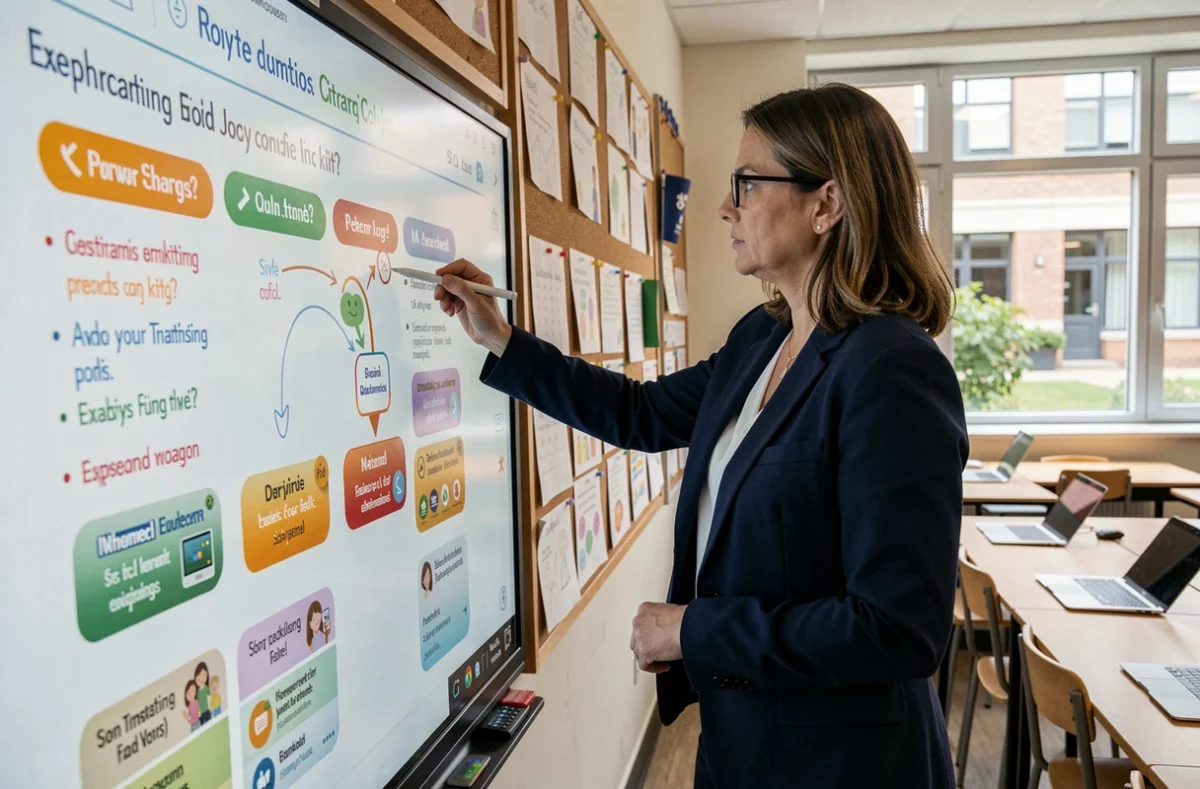
The replacement of the C2i2e by the CRCN Edu, formalized by a decree published in the Official Journal on July 28, 2026, redefines the digital skills framework required of educational staff. This change in the reference framework, structured around PIX, is not limited to an administrative update: it imposes a cross-evaluation of technical skills and their pedagogical transposition, which concretely modifies initial and continuing training pathways.
CRCN Edu and PIX certification: what the new framework changes for teachers
The C2i2e certified a level of office and documentary skills that has become obsolete in light of current practices. The CRCN Edu restructures the evaluation around areas that include the production of digital resources, technology-assisted pedagogical differentiation, and the protection of students’ data.
The open question remains that of obligation. The decree sets the framework, but the application modalities vary by academy. Some INSPÉ have already integrated PIX modules into their curriculum, while others have not yet adapted their pathways. This discrepancy creates a de facto inequality among trainee teachers depending on their training location.
For staff already in position, the PIX Edu certification operates on a voluntary basis in most cases. We observe that academic training plans struggle to meet the demand when it exists, due to a lack of certified trainers in sufficient numbers.
AI in the classroom: the French debate on pedagogical proof
The integration of artificial intelligence in French schools faces a methodological problem: the absence of large-scale randomized trials to measure the actual impact on learning. The question remains: should we wait for scientific proof before deploying AI, or decide without it?
In France, the institutional stance oscillates between occasional prohibitions and uncoordinated local experiments. Several teacher collectives that relay news on Échos D’École document this tension between ministerial injunctions and ground realities.

The main risk is not AI itself, but the deployment of tools without an evaluation protocol. Applications for automated grading or generating adaptive exercises are already being used in some institutions, without structured feedback on their effectiveness compared to traditional methods.
What the general inspections are monitoring
Recent inspection reports target three points: the GDPR compliance of tools used in the classroom, the algorithmic transparency of adaptive learning platforms, and teacher training in identifying biases in generated content. These criteria remain largely declarative due to the lack of a standardized audit framework.
Teacher shortage: UNESCO data and its limits
UNESCO warns of the need to massively recruit additional teachers worldwide by 2030. The exact number varies according to projections, but the observation is shared: departures from the profession exceed entries in many countries, including France.
UNESCO’s analysis points to two aggravating factors:
- The burden of work outside the classroom (preparations, grading, administrative tasks, institutional meetings) which extends the actual working time well beyond the time spent in front of students.
- The feeling of lack of recognition, measured by surveys of staff, which directly correlates with the intention to leave the profession.
These aggregated data mask disparities. The shortage does not uniformly affect all subjects or all regions.
Equity in educational funding: the new UNESCO index
UNESCO has developed an analysis framework to examine the equity of educational funding on a global scale. The tool measures the policies engaged and the resources allocated, not the results obtained. This distinction is fundamental: a country can display a high score for equitable policy while maintaining significant outcome gaps between advantaged and disadvantaged students.
The index crosses several dimensions: the share of the educational budget allocated to priority areas, the redistribution mechanisms between local authorities, and the existence of targeted measures for vulnerable populations. In France, priority education networks (REP and REP+) fall within this scope, but their evaluation remains debated.
Educational funding in France: the blind spots
Educational funding in France relies on a layering of contributors (State, regions, departments, municipalities, EPCI) whose coordination is not always clear. Disparities in spending per student between local authorities persist, particularly regarding school infrastructure and digital equipment.
The UNESCO index also does not capture private funding (tutoring, private lessons, subscriptions to educational platforms) that exacerbates inequalities outside the public scope.

Following educational news: beyond ministerial announcements
Institutional portals (education.gouv.fr, éduscol) publish official texts and press releases. General media cover controversies and social movements. Between the two, the monitoring of the concrete application of reforms remains a poorly covered angle.
Specialized sources such as academic websites and sectoral monitoring platforms allow for cross-referencing political announcements with ground feedback. Knowing that a decree has been published says nothing about its actual application six months later in a rural middle school or a vocational high school in the suburbs.
The recent mobilization of high school students, the questions surrounding substitutes, and the overhaul of digital certifications illustrate this ongoing gap between political tempo and school tempo. Following education in real-time also means accepting that most transformations are measured over years, not over news cycles.