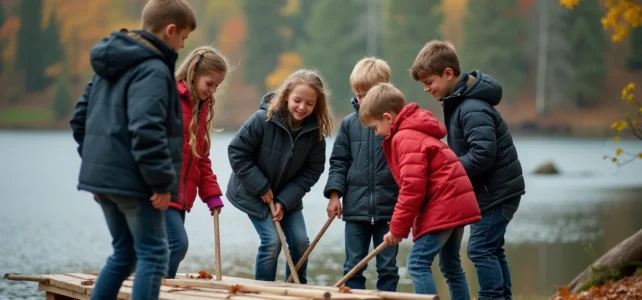
The lack of direct contact with the field is one of the main limitations of traditional classroom learning. Yet, every year, institutions still hesitate to organize school trips, citing logistical or budgetary constraints.
The data from the Ministry of National Education speaks for itself: those who experience a collective stay outside of school develop transversal skills at a significantly faster rate than their peers who remain in the classroom. These escapades are not just simple outings: they shape, in students, autonomy and a sense of community, far exceeding the transmission of purely academic concepts.
Why discovery classes leave a lasting impression on students
Stepping out of the classroom and experiencing life at a different pace. Discovery classes spontaneously create a dynamic of experimentation: with each stay, students are exposed to new settings, awaken to heritage, and gain a fresh perspective on nature or traditions. Away from the daily routine, balances shift: the group reinvents itself, affinities express themselves differently, and responsibilities are shared.
The impact of this type of trip is manifested concretely through several dimensions:
- Promoting solidarity and encouraging daily mutual aid
- Stimulating students’ curiosity and fostering their autonomy
- Building confidence by valuing personal initiative
On site, the discovery class acts as a revealer. Children dare more, change their posture, and speak up more easily. Even the quietest find their place, sometimes unexpectedly. Abstract knowledge finally comes to life: observing stars, recognizing a plant, or talking with a craftsman—all of this is imprinted in memory differently than on paper.
Teachers often mention the effect of these stays: the memories, friendships, and group energy persist long after returning to school. To get a glimpse of these experiences, just discover going to class: a window into a learning experience perceived as a whole, rooted in sharing and collective emotions. Educational school trips thus leave real traces, much deeper than one might sometimes imagine.
What types of stays to choose according to the needs and desires of the class?
No two classes are truly alike: desires, projects, and needs vary from group to group. The offer of school trips has adapted, multiplying options to meet all profiles and educational objectives. For some, immersion is key, at the heart of the natural environment:
- mountains
- coastline
- countryside
Discovering ecosystems, observing wildlife, hiking, or learning navigation skills: these activities nourish scientific inquiry and active observation. Other groups prioritize cultural exploration: visits to historical sites, museums, or workshops with artisans, to engage students in discovering local history and cultures.
Some projects go further, addressing societal themes. Several teachers take their classes to engaged locations, with activities focused on ecology, social economy, and inclusion, to spark awareness and foster a taste for civic debate.
Different themes regularly emerge in the choice of stays:
- Nature and biodiversity: cultivating sensitivity to living things and ecological awareness
- Heritage and culture: embedding learning in collective memory
- Civic engagement: opening the field for reflection and exchange about our society
If the school trip is successful, it is mainly because it aligns with the group’s dynamics, needs, and curiosity. Everything begins with a dialogue between adults and children to align objectives, anticipate constraints, and refine the project. This shared reflection then paves the way for the most fulfilling option for the class.
Practical tips for organizing an unforgettable school trip
Planning a school trip starts with agreeing on the project, outlining the main points, and then moving forward methodically. It is primarily about clarifying, together, what experiences are desired: discovery, sports, cohesion, cultural or natural immersion.
Once the outlines are established, it’s time to create the program: alternating learning times with those conducive to relaxation. It’s better to prioritize a selection of well-planned activities than to have an overly packed schedule. Involving students in the preparation makes them more invested and responsible. On the logistics side, strictness is essential: formalities, insurance, accommodation, meal organization—nothing should be left to chance. It is also about ensuring flawless safety for everyone’s comfort.
The budget, often daunting, should be anticipated on several levels. Different levers can be activated: applying for grants, organizing sales or raffles, support from the municipality or local partners. Families should be able to clearly understand the project: details about costs, benefits for the children—everything must be explained transparently.
Here are some key points to keep in mind throughout the preparation:
- Structure all steps, from choosing the location to evaluating the stay
- Ensure regular communication with families, the teaching team, the children, and the facilitators
- Adapt the pace and duration according to the age and specific needs of the group
A well-executed school trip is often the moment that transforms the year: the class returns united, enriched by a shared experience, with indelible memories that will accompany each student for a long time.