
On a a turbo diesel engine of 150 horsepower, you often gain between ten and thirty horsepower with a simple software modification of the ECU. No parts to change, no hood open for hours.
Stage 1 remains the most common engine remapping because it only affects the ECU software, adjusting the injection mapping, boost pressure, and ignition timing. The gain is felt from the first few meters, especially at mid-rev range, where the engine is used daily.
Stage 1 on plug-in hybrids: what the high-voltage battery really endures
There is a lot of talk about remapping on traditional thermal engines. On modern hybrids, the subject becomes more delicate. Modifying the thermal engine mapping of a plug-in hybrid vehicle changes how the energy management system distributes the load between the gasoline engine and the high-voltage battery.
When the thermal engine produces more torque after a stage 1, the hybrid ECU compensates by differently engaging the electric motor. The charge and discharge cycles of the battery are modified, sometimes significantly in urban cycles.
No tuner currently quantifies the impact on the lifespan of the high-voltage battery. Feedback varies on this point because testing protocols simply do not exist for this configuration. An ADAC report from 2025 measured a 15% higher energy optimization in mixed urban cycles when combining stage 1 and E85 on a plug-in hybrid, but this same report does not cover the long-term degradation of lithium-ion cells.
If you drive a hybrid and are considering the benefits of stage 1 on a car of this type, ask the tuner about the battery warranty. On a battery pack that costs several thousand euros to replace, the risk should be clarified before any intervention.
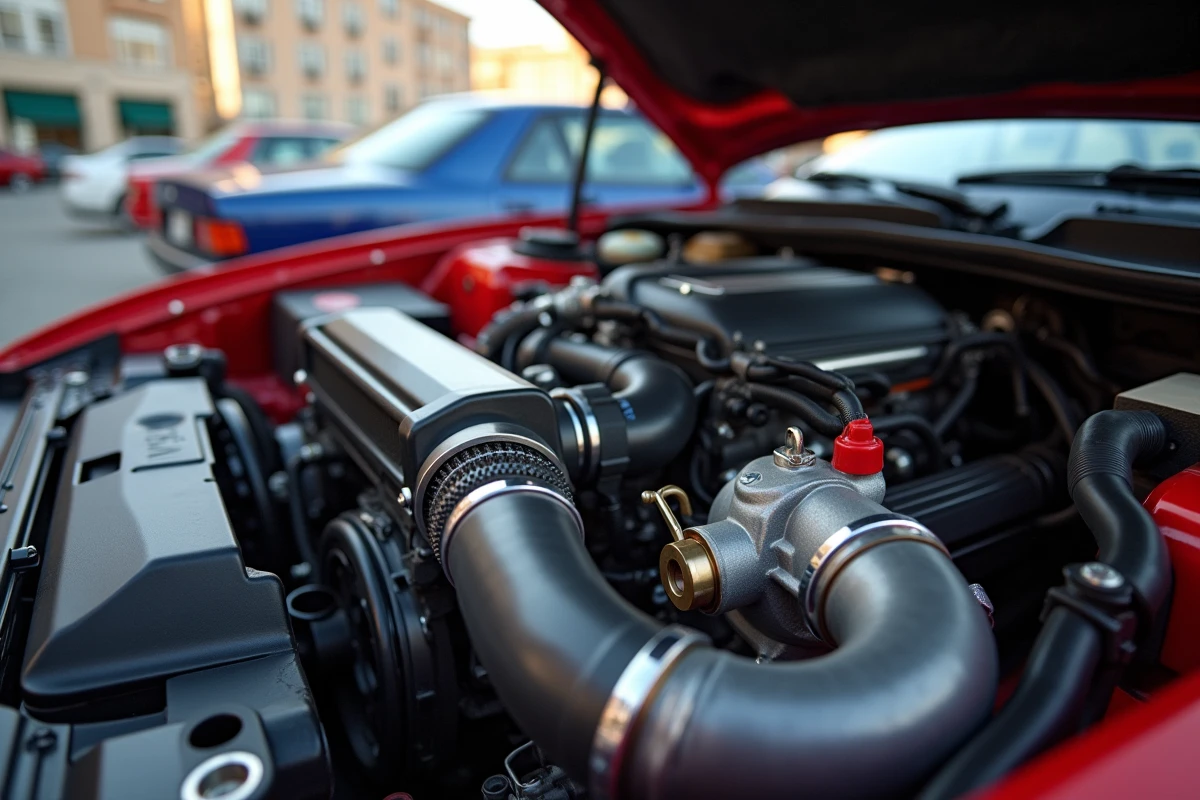
Engine mapping and real gains: diesel vs gasoline after stage 1 remapping
Turbo diesel engines make the most of a stage 1. The reason is technical: a turbo diesel has a boost pressure margin that the manufacturer intentionally restricts to homologate the vehicle at several power levels with the same engine. Releasing this margin through remapping produces a significant torque gain at low and mid-rev ranges.
On a naturally aspirated gasoline engine (without turbo), the gain remains marginal. The original mapping leaves little room, and optimization is limited to fine-tuning the ignition timing and injection durations. We’re talking about a few horsepower, rarely noticeable at the wheel.
Parameters modified in a stage 1
- Boost pressure (turbo): the parameter that generates the most gain on supercharged engines, utilizing the mechanical tolerance of the turbocharger
- Fuel injection mapping: adjustment of the quantity and timing of injection to accommodate the additional pressure without leaning out the mixture
- Ignition timing (gasoline): optimized timing to extract the maximum energy from each combustion cycle, within knock limits
- Torque limiter in first and second: some tuners raise these thresholds, improving acceleration but putting more strain on the gearbox
Torque increases proportionally more than power, which explains the clear improvement felt in daily driving, during overtaking or entering the highway.
Fuel consumption after a stage 1: real gain or marketing promise
Tuners often announce a reduction in fuel consumption after remapping. On paper, this makes sense: an engine that produces more torque at low revs requires less throttle to maintain a stable speed.
In practice, the result depends on the driver. You consume less only if you do not change your driving style. However, with more power available, the temptation to press harder exists. On the road, with smooth and steady driving, the reduction in consumption is measurable. In the city, with frequent accelerations, it disappears.
The determining factor remains the weight of the right foot, not the mapping.

Technical inspection and December 2023 decree: what has changed for remapped cars
Since decree n° 2023-1205 of December 28, 2023, technical inspections include stricter checks on pollutant emissions and declared power. A remapped vehicle can be refused if the actual power no longer corresponds to the registration certificate.
Before this date, most stage 1 remaps went unnoticed during technical inspections. Gas analyzers did not detect power discrepancies, and the check was limited to gross emissions. The Senate report from March 15, 2025, confirmed the tightening of these checks, with an increasing number of refusals for non-compliance.
Points to check before getting remapped
- Does the tuner offer a return to the original mapping before the technical inspection (anti-tune function or stock map restore)
- Is the modification reversible without leaving a trace in the ECU, a point that all manufacturer diagnostic tools do not handle in the same way
- Is your insurer informed of the modification, as an undeclared remapping can lead to a refusal of coverage in case of a claim
The legal framework is clear: any modification of engine power must be declared and recorded on the registration document. Failing to do so exposes you to a fine and, more importantly, a lack of insurance coverage in case of an accident.
Stage 1 remains the most accessible entry point to improve a vehicle’s performance, provided the topic is treated with the same rigor as a mechanical modification. Choosing a tuner who provides a stock return file, checking compatibility with your insurance, and on a hybrid, demanding data on battery impact: these precautions make the difference between a lasting gain and an expensive problem.