
A group of volunteers decides to liven up the village, books a hall, sets up a refreshment stand, and sends out invitations. A few weeks later, the town hall requests a proof of insurance, the prefecture demands a declaration, and SACEM sends a form. Understanding the obligations of a festival committee before getting started avoids these unpleasant surprises and protects both the organizers and the public.
Climate Risks and Contingency Plan: An Obligation Often Overlooked by Guides
Since 2023, several prefectures, including that of Rhône (circular to mayors dated June 7, 2023), require outdoor event organizers to include a heatwave and severe storm management plan. For a festival committee planning a countryside meal in July or a dance in August, this climate aspect is no longer optional.
Specifically, the file submitted to the town hall must include shaded or covered fallback areas, water distribution points, prevention messages displayed at the event site, and a rapid cancellation procedure if Météo-France issues an orange or red alert for the department.
Are you organizing a village festival in the middle of summer? Check with your prefecture if there is a specific note for your department. Guidelines vary from one area to another, but the principle remains the same: the organizer is responsible for public safety in the face of weather hazards.
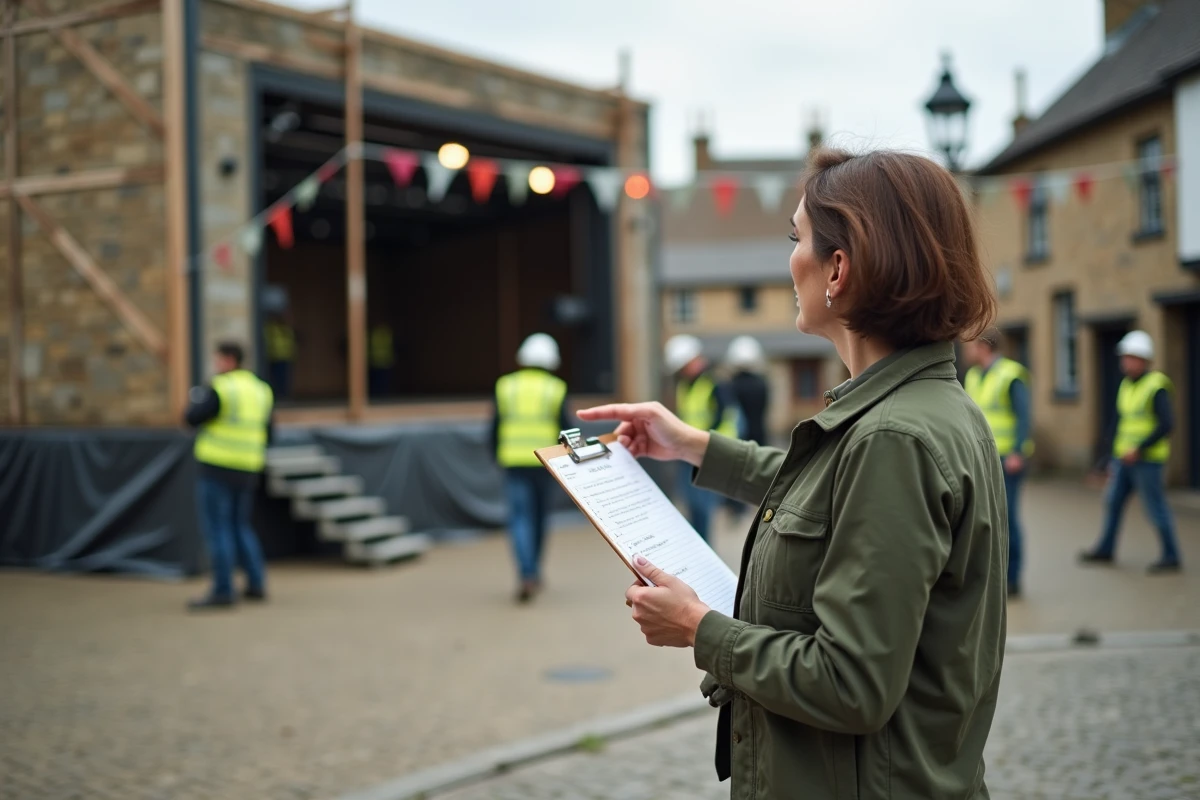
Declaration to the Prefecture, Insurance, and License: The Legal Foundation of the Festival Committee
A festival committee is an association governed by the 1901 law. Its creation involves drafting statutes (name, purpose, registered office, list of members) and a declaration to the prefecture of the department. Without this formality, the association has no legal existence and cannot open a bank account or sign an agreement with the town hall. A comprehensive guide on the obligations of a festival committee helps structure each step of this process.
Liability Insurance
Any event open to the public requires liability insurance. It covers damages caused to participants, third parties, and property. The town hall may refuse to lend a venue (event hall, municipal park) if the certificate is not provided in advance.
Be sure to check the exclusions of the policy. Some policies do not cover inflatable structures, fireworks, or equestrian activities. Each activity added to the program must be included in the declaration made to the insurer.
Temporary Beverage License
If your festival committee operates a refreshment stand, municipal authorization is mandatory. Only beverages from the first two categories (non-alcoholic and fermented drinks such as wine, beer, cider) can be sold under a temporary license. Strong alcohols (whiskey, vodka, rum) are prohibited at these community events.
- Submit the temporary beverage license application to the town hall at least fifteen days before the event.
- Designate a responsible person for the refreshment stand, identifiable on-site.
- Display prices and regulations regarding the sale of alcohol to minors and public intoxication enforcement.
SACEM Declaration, Sound System, and Noise Pollution
As soon as an event plays music, whether it’s a DJ set, a live concert, or a simple amplified playlist, SACEM comes into play. The festival committee must declare the event to SACEM and pay the corresponding copyright fees. The amount depends on the type of event, the size of the audience, and whether the entry is paid or free.
Regarding noise pollution, the public health code regulates sound pressure levels. For an outdoor stage, the power of the sound system must be calibrated according to the surrounding area. A complaint for noise disturbance can personally implicate the president of the association.
A useful reflex: notify nearby residents by mail or posting a few days before the festival. This step does not eliminate legal risk, but it reduces the likelihood of conflict.

Energy Efficiency of Local Events: A Growing Expectation from Municipalities
Following the energy efficiency plan presented by the government on October 6, 2022, several municipalities have adopted local charters that directly concern festival committees. These charters call for reducing decorative lighting, limiting sound power, and prioritizing low-energy equipment (LEDs, optimized generators).
Have you ever calculated the electricity consumption of a village festival? Between garlands, sound systems, refreshment stand refrigerators, and security lighting, the bill can add up quickly. Pooling equipment with other local associations (lending tents, sharing generators) is a practical way to reduce both costs and environmental impact.
These expectations are not yet codified in a national text specific to festival committees, but the trend is clear. Integrating this aspect into the management of your event demonstrates a concrete commitment to the community that hosts you.
Venue Safety and Obligations Related to Public Reception
When a festival committee uses a public establishment (ERP), such as an event hall or gymnasium, fire safety and accessibility standards apply. The maximum capacity must never be exceeded. Emergency exits must remain clear and marked throughout the event.
- Check that fire extinguishers are in place and up to date.
- Prohibit any electrical DIY: daisy chaining and non-compliant extension cords are the leading cause of incidents at local festivals.
- If the event occupies public space (parade, race, market), a municipal road closure order is necessary, to be requested from the town hall.
- Plan for a first aid station or, at a minimum, a first aid kit and a volunteer trained in emergency procedures.
The organizer who omits a declaration or authorization engages their civil and sometimes criminal liability. The regulatory framework may seem burdensome for a neighborhood festival, but each formality protects both the public and the volunteers. It is better to spend an hour on an administrative file than to manage an accident without coverage.